
The best answer app for all subjects is ours, ThinkAssist: take a picture of any homework question on your iPhone or iPad and it gives you the answer and shows how it got there. Google Lens finds questions already answered online, Brainly is a forum where other students answer textbook questions, and Photomath sticks to math. Keep the steps, though: a test that says "show your work" won't take the answer alone.
For more options, see our full comparison of today's top homework apps.
What are the best apps that give you the answer to your homework in 2026?
The best tools right now are ThinkAssist, Photomath, and Google Lens, depending on whether you need a general tutor or a strict math calculator.
I compiled a breakdown of the tools that actually work when you are stuck on a weekend assignment.
| App Name | Best For | OCR Quality | Price Point |
|---|---|---|---|
| ThinkAssist | Best Overall (All Subjects) | Excellent (Handles cursive) | Free trial, then $6.99/wk |
| Photomath | Strict Math Equations | Very Good | Free / $9.99 per mo |
| Google Lens (replaced Socratic in 2025) | Text-heavy questions | Good | 100% Free |
| Brainly | Peer-to-peer textbook Q&A | Average | $9.99 per mo |
What sets ThinkAssist apart from the others in that table is automatic subject detection.
You do not have to flip between a "math mode" and a "history mode." It just reads the context of the photo.
Which app has the best homework answers for math, science and history?
For homework answers in every subject, ThinkAssist is the app to keep on your phone; a single-subject app only makes sense when one class is all you need.
- Science, history, languages, or a mix: ThinkAssist. One photo of the question, printed or handwritten, and the answer comes with its explanation.
- Math only, printed equations: Photomath. It works through anything from arithmetic to calculus one step at a time, and Photomath Plus is $9.99 a month.
- College math: Mathway, from Chegg. Its steps are a subscription, from $9.99 a month on the App Store as of November 2026.
- A question that's already answered online: Google Lens, free. It finds the study guides and pages that cover it.
If math is the only class you need it for, see our comparison of math solver apps; for scanning, the best app to scan questions and get answers.
How do I scan a physical worksheet with AI homework apps?
You simply open the app's camera interface, align the question inside the viewfinder box, and tap the capture button.
If you are dealing with a massive block of text, the AI will isolate the core question. My guide explains how AI photo solvers work and how accurate they are.
- Flatten the paper on a well-lit desk to avoid shadows.
- Center one specific question in the camera frame.
- Review the cropped image before hitting "Solve" so the engine does not read an adjacent problem by mistake.
Can I upload a PDF file instead of using the camera in AI homework apps?
Yes, most top-tier platforms allow you to import screenshots or PDF files directly from your phone's gallery.
This is incredibly helpful for online assignments where you cannot easily snap a picture of your laptop screen without getting nasty glare lines.
What are the best apps like Question AI for solving homework?
Question AI gained popularity as a study assistant that lets students solve problems through photo scans and text prompts. Alternative tools like ThinkAssist, Google Lens, and Photomath offer comparable scanning and explanation features catered to different academic needs.
While Question AI relies on conversational prompts, ThinkAssist uses automatic subject detection to process questions across all subjects without switching modes. For pure text-based queries, Google Lens now does what Google's discontinued Socratic app did: it pulls relevant web resources and visual explanations from a scanned worksheet. Students looking for apps like Question AI should choose based on whether they need single-subject math solvers or multi-subject tools with automatic visual detection.
Do AI homework solvers just give answers or explain steps?
Legitimate study tools force you to read through the logical steps before they show you the final answer.
If an app just hands you a "42" without context, it fails as a learning tool. You need the intermediate steps to pass an actual exam.
We actually want to learn the material, contrary to what some professors think.
Core benefits of step-by-step engines:
- Highlighting specific algebra rules applied in row three.
- Explaining why a specific historical date matters for context.
- Defining complex vocabulary words right inside the answer block.
What happens if AI homework solvers give the wrong answer?
You will get a hallucination, which happens quietly in about 5% of complex inputs, so you must cross-reference strange results.
You cannot blindly copy the output. If the logic suddenly jumps from basic algebra to advanced calculus for a standard problem, the AI is probably making a mistake.
How does AI read messy handwriting or complex graphs in homework solvers?
Modern OCR uses transformer models trained specifically on billions of human handwriting samples to clear up weird loops and smudged pencil marks.
I throw some aggressively bad cursive at these systems. Unless the ink is completely faded, the OCR grabs the text flawlessly.
How do you choose the best question answer app for your subject?
Selecting the best question answer app depends on the main subject you need help with and the format of your assignment. Math problems require precise formula breakdown, while humanities subjects require broad natural language understanding. If your work goes beyond homework, compare problem solving apps for coding, math, and brainstorming.
Key features to evaluate before picking a solver:
- Subject versatility: Multi-subject apps automatically detect context from photos so you do not need separate apps for history and chemistry.
- Input options: Ensure the app handles physical paper scans, screenshot uploads, and PDF files.
- Step-by-step logic: Reliable platforms break down every logical step before revealing final outputs.
- Device compatibility: Confirm support on your mobile platform by reviewing store listings on the Apple App Store.
As explained on Wikipedia, modern optical character recognition converts image text into machine-readable data, enabling modern solvers to process printed and handwritten queries rapidly.
Are AI homework apps cheating or legitimate study tools?
These apps are legitimate study tools when you use them to reverse-engineer a concept, but they easily become cheating aids if you just copy the final block of text.
The education sector spent all of 2024 panicking about this. Now, in 2026, the conversation is entirely different.
Professors are currently arguing about how to integrate these scanners into the curriculum instead of banning them. A 2025 randomized controlled trial in Scientific Reports found that students taught with an AI tutor learned more in less time than in an active-learning class.
If you stare at a blank page for three hours, you learn nothing. If you get a hint from an app, you build momentum.
Can my teacher tell if I used an AI math solver?
In math, your teacher will know if you show working steps that use theorems your class has not learned yet.
History and English are tougher to spot unless the tone of your essay sounds completely robotic.
- Keep your vocabulary at your actual reading level.
- Always rewrite generated concepts in your own normal speaking voice.
- If the AI uses an obscure algebra shortcut, do not write it on your test paper.
Does my school WiFi block AI homework apps?
Yes, a lot of public high school networks actively block the IP addresses of known AI platforms.
I honestly think this is a waste of IT resources, but it happens everywhere. You usually have to disconnect from the school WiFi and use your cellular data to snap a picture.
Do I need to pay for a subscription to use an AI homework solver?
You can usually scan basic equations for free, but detailed explanations and specific subject features will cost a monthly fee.
Running these large language models costs the developers server money. I get why they lock the premium features behind a paywall.
A high-end scanner normally runs between $8 and $15 per month. That's a real cost on a tight budget, but it's far less than a $50-per-hour human tutor.
Which AI homework app should I download to save past test answers?
You should grab an app that features an automatic archive, as this allows you to review historical scans during exam week.
I rely on the ThinkAssist history log for exactly this reason. When midterms hit, I just scroll backward through all the questions I struggled with over the last 60 days.
This beats frantically flipping through scattered spiral notebooks.
Are there any privacy concerns with scanning my textbooks in AI apps?
Most user agreements state the developer will use your uploaded images to train future versions of the OCR engine.
Do not scan documents that contain your real name, address, or school ID number. Stick strictly to the math problems and history prompts.
Can I use homework answer apps offline?
Mostly not: AI homework apps send your photo to cloud servers, so they need an internet connection to solve it. The heavy lifting doesn't happen on your phone's processor; it happens in a data center.
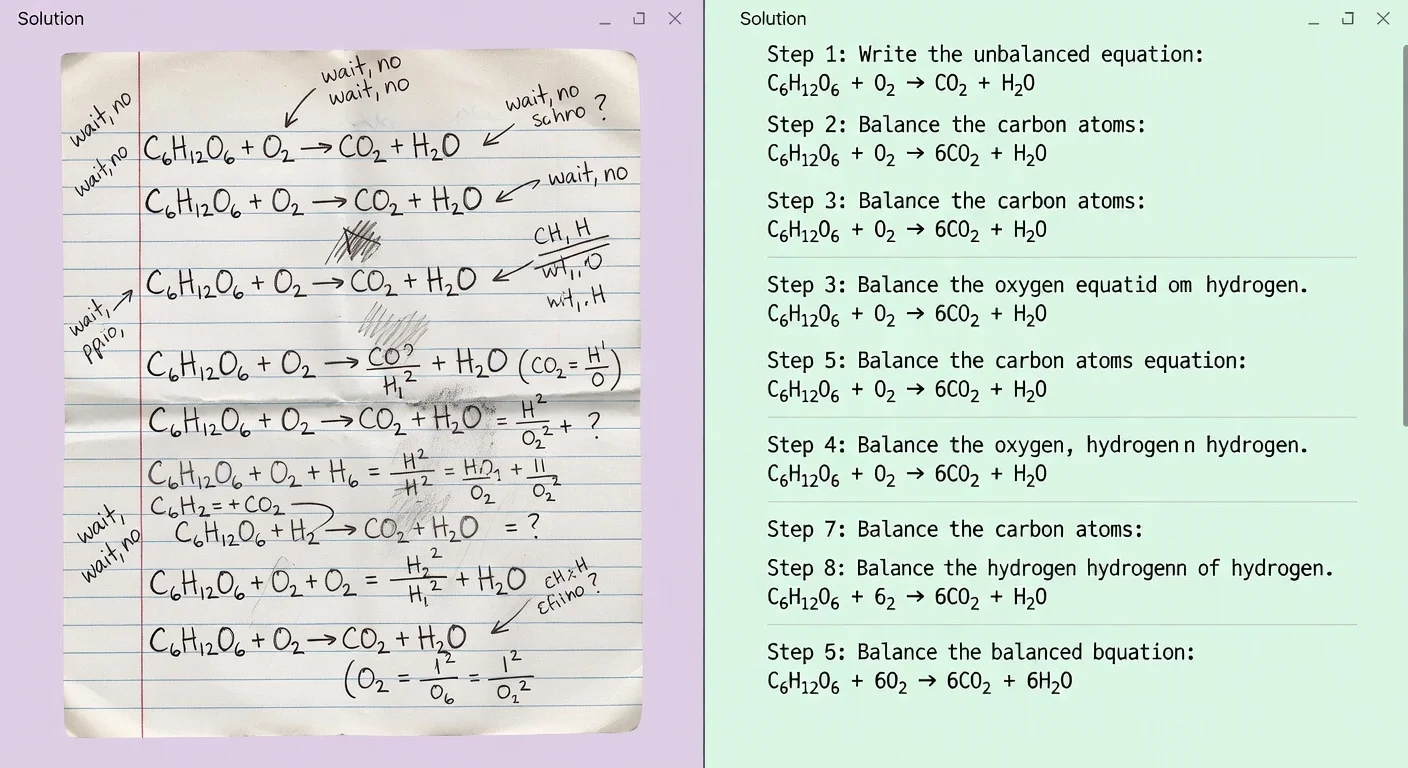
A few basic arithmetic scanners still work in airplane mode. But for anything beyond that, like balancing a chemical equation or explaining a biology diagram, your phone doesn't hold the models or reference material locally.
I once tried three scanner apps in a basement with no cell reception. Each one took the photo fine, then the loading wheel spun until I walked outside and caught a signal. If you study somewhere without Wi-Fi, check that you have mobile data before you count on an app.
How accurate are AI homework apps for college-level courses?
They perform incredibly well for introductory college courses (calculus, basic chemistry, freshman history), but they struggle heavily with niche, upper-level university concepts.
If you need help with high school geometry, you are totally fine. If you feed the app a problem from a 400-level quantum physics textbook, it will likely break.
The models rely on the data they ingested. There are simply fewer physics thesis papers out there compared to middle school algebra worksheets.
Accuracy breakdown by subject:
- Algebra / Calculus: 95% accurate.
- Language Arts: 90% accurate.
- Organic Chemistry: 70% accurate (struggles with complex spatial diagrams).
- Advanced Engineering: 40% accurate.
Will AI homework apps replace human tutors entirely?
No, because a human tutor reads your facial expressions to see if you are actually absorbing the material.
An app cannot tell if you are frustrated or just tired. It just serves up the text on a plate.
I still think a great teacher is worth more than a piece of software. But if it is 2 AM on a Tuesday, an app is drastically better than zero help at all.
Frequently Asked Questions
Are AI homework answer apps free?
Most offer a limited free tier, but full step-by-step logic usually requires a premium subscription ranging from $8 to $15 per month.
Can AI homework solvers read messy cursive handwriting?
Yes, modern OCR engines can read cursive with about 90% accuracy, provided the lighting is good and the ink is completely legible.
Do AI homework solvers save previous questions for test prep?
Certain tools like ThinkAssist automatically save your scanned assignments, so you can copy an answer or come back to the conversation before midterms and finals.
Do homework answer apps work for science and history?
Some do. ThinkAssist works out the answer from a photo of a science or history question and explains it, and Google Lens finds pages that already cover it. A math-only app like Photomath doesn't.
How long does an answer app take to solve a question?
A few seconds. ThinkAssist answers in about 2 to 4 seconds on a normal connection.
Is using a camera solver app considered academic cheating?
If you just copy the final output, yes. If you use the generated steps to reverse-engineer a concept you do not understand, it is a study aid.