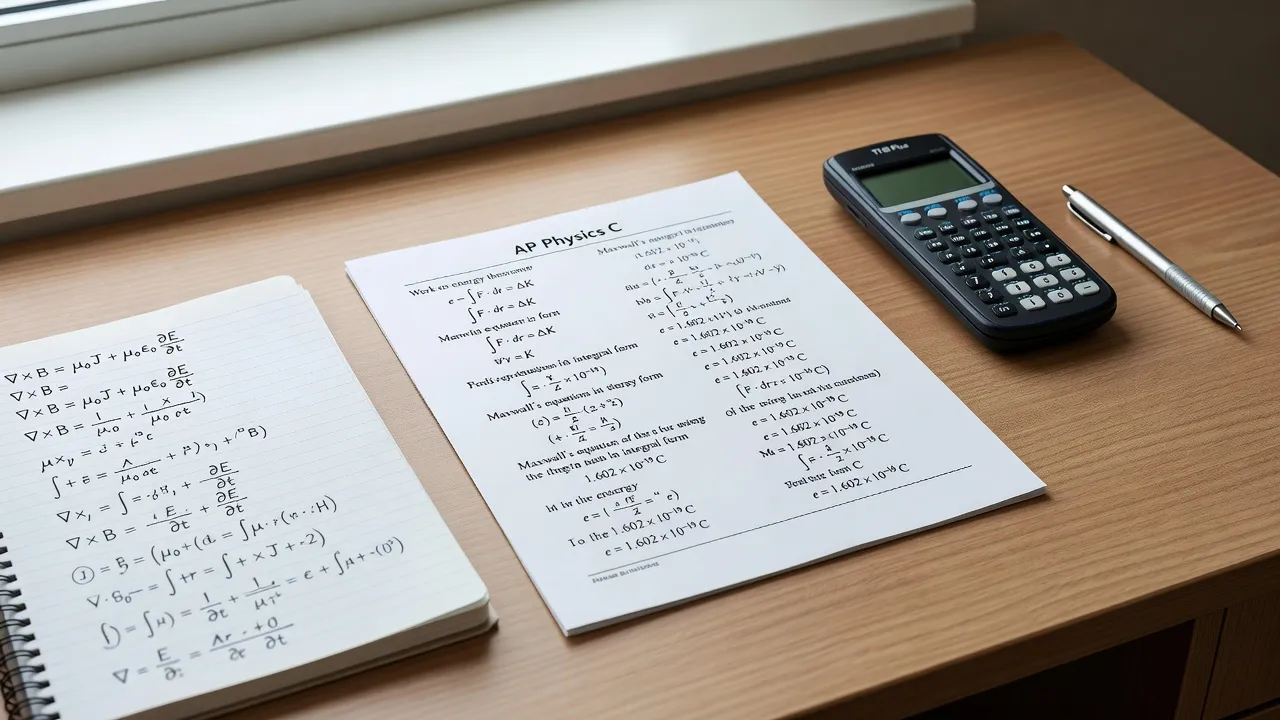

There are two AP Physics C equation sheets, one for each exam: AP Physics C: Mechanics (PDF) and AP Physics C: Electricity and Magnetism (PDF). Each AP Physics C equation sheet is the reference booklet the College Board hands out during that exam, and both are free to download. The Mechanics booklet has three pages of tables and equations; the Electricity and Magnetism booklet has four, because it repeats the mechanics page.
The sheet tells you what an equation is, not which one a problem calls for. If a practice problem leaves you unsure where to start, snap it with ThinkAssist, our homework app for iPhone and iPad: you get the solution explained from the first equation to the answer.
Every equation on both booklets is listed below, with what's missing from them and the rules for exam day.
Where to download the official AP Physics C equation sheet PDF (2026-27)
Both official PDFs for the 2026-27 school year and the May 2027 exams are free on the College Board's reference information page, which also lists the sheets for AP Physics 1 and AP Physics 2. Many copies in search results are older, some dated 2008 or 2012, from when both exams shared one sheet. The College Board calls the booklet "Exam Reference Information"; students call it the equation sheet, formula sheet or reference sheet. It is the same document.
| AP Physics C: Mechanics | AP Physics C: Electricity and Magnetism | |
|---|---|---|
| Official PDF | Mechanics equation sheet | E&M equation sheet |
| Length | Cover + 3 pages | Cover + 4 pages |
| Page 1 | Table of information: constants (G and g only), prefixes, unit symbols, trig values, conventions | Table of information: constants (G, g and ten electric and magnetic ones), prefixes, unit symbols, trig values, conventions |
| Equation pages | Mechanics | Electricity and magnetism, then mechanics |
| Last page | Geometry, trigonometry, vectors, calculus, identities | The same math page |
| 2027 exam date | Monday, May 3, 2027 | Wednesday, May 5, 2027 |
On exam day you don't bring your own copy. According to the College Board, the booklets are printed and mailed to schools, and the same reference information is available in the Bluebook testing app in the test preview and on exam day. The proctor hands out the booklet and collects it at the end.
If you are in AP Physics 1 instead, that exam has a different, algebra-based sheet: see our guide to the AP Physics 1 reference sheet.
What is on the AP Physics C: Mechanics equation sheet?
The AP Physics C: Mechanics equation sheet has one page of equations covering kinematics, center of mass, forces, energy and power, momentum, rotation, and oscillations. They are grouped by topic below. Subscripts are written here with an underscore: v_x0 is the initial velocity in the x direction, I_cm the rotational inertia about the center of mass.
| Topic | Equations on the sheet |
|---|---|
| Kinematics | v_x = v_x0 + a_x·t x = x_0 + v_x0·t + ½·a_x·t² v_x² = v_x0² + 2·a_x·(x − x_0) Δx = ∫ v_x(t) dt Δv_x = ∫ a_x(t) dt |
| Center of mass | x_cm = Σ m_i·x_i / Σ m_i r_cm = ∫ r dm / ∫ dm λ = dm/dℓ v_cm = Σ p_i / Σ m_i |
| Forces | a_sys = ΣF / m_sys = F_net / m_sys F_g = G·m_1·m_2 / r² F_f ≤ μ·F_N F_s = −k·Δx a_c = v²/r = r·ω² |
| Work, energy, power | K = ½·m·v² W = ∫ F · dr ΔK = Σ W_i = Σ F_∥·d ΔU = −∫ F_cf · dr F_x = −dU/dx U_s = ½·k·(Δx)² U_G = −G·m_1·m_2 / r ΔU_g = m·g·Δy P_avg = W/Δt = ΔE/Δt P_inst = dW/dt |
| Momentum | p = m·v F_net = dp/dt J = ∫ F_net(t) dt = Δp |
| Rotation | ω = dθ/dt α = dω/dt ω = ω_0 + α·t θ = θ_0 + ω_0·t + ½·α·t² ω² = ω_0² + 2·α·(θ − θ_0) v = r·ω a_T = r·α τ = r × F I_tot = Σ I_i = Σ m_i·r_i² I = ∫ r² dm I′ = I_cm + M·d² α_sys = Στ / I_sys K_rot = ½·I·ω² W = ∫ τ dθ L = r × p = I·ω ΔL = ∫ τ dt Δx_cm = r·Δθ |
| Oscillations | T = 1/f = 2π/ω T_s = 2π·√(m/k) T_p = 2π·√(ℓ/g) T_phys = 2π·√(I/(m·g·d)) x = x_max·cos(ω·t + φ) |
The first page gives only two constants for Mechanics: the universal gravitational constant, G = 6.67 × 10⁻¹¹ N·m²/kg², and g = 9.8 m/s² (also written as 9.8 N/kg). It also states three conventions the exam uses unless a question says otherwise: the frame of reference is inertial, air resistance is negligible, and springs and strings are ideal.
In these, F_cf is a conservative force, F_∥ the part of a force along the displacement, a_T the tangential acceleration, and d in T_phys the distance from the pivot to the center of mass.
For how the oscillation equations fit together, see our walkthrough of the simple harmonic motion equation.
What is on the AP Physics C: Electricity and Magnetism equation sheet?
The AP Physics C: Electricity and Magnetism equation sheet has one page of E&M equations covering electrostatics, capacitors, current and circuits, magnetism and induction, followed by the full mechanics page.
| Topic | Equations on the sheet |
|---|---|
| Electrostatics | F_E = k·q_1·q_2 / r², with k = 1/(4π·ε_0) E = F_E / q E = k·∫ dq/r² Φ_E = ∫ E · dA ∮ E · dA = q_enc / ε_0 (Gauss's law) Q_total = ∫ ρ(r) dV U_E = k·q_1·q_2 / r V = k·∫ dq/r ΔV = −∫ E · dr E_x = −dV/dx ΔU_E = q·ΔV |
| Capacitors | C = Q/ΔV C = κ·ε_0·A / d U_C = ½·Q·ΔV κ = ε/ε_0 1/C_eq,s = Σ 1/C_i C_eq,p = Σ C_i |
| Current and circuits | I = dq/dt I = ∫ J · dA E = ρ·J R = ρ·ℓ / A I = ΔV/R P = I·ΔV R_eq,s = Σ R_i 1/R_eq,p = Σ 1/R_i τ = R_eq·C_eq |
| Magnetism | ∮ B · dA = 0 F_B = q·(v × B) dB = (μ_0/4π)·I·(dℓ × r̂) / r² (Biot-Savart law) F_B = ∫ I·(dℓ × B) ∮ B · dℓ = μ_0·I_enc (Ampère's law) B_sol = μ_0·n·I Φ_B = ∫ B · dA |
| Induction and inductors | ε = ∮ E · dℓ = −dΦ_B/dt (Faraday's law) ε_sol = N·dΦ_B/dt (magnitude) L_sol = μ_core·N²·A / ℓ U_L = ½·L·I² ε = −L·dI/dt τ = L / R_eq ω_LC = 1/√(L·C) |
The E&M table of information carries the constants you'd otherwise have to memorize:
| Constant | Value on the sheet |
|---|---|
| Coulomb constant | k = 9.0 × 10⁹ N·m²/C² |
| Vacuum permittivity | ε_0 = 8.85 × 10⁻¹² C²/(N·m²) |
| Vacuum permeability | μ_0 = 4π × 10⁻⁷ T·m/A |
| Elementary charge | e = 1.60 × 10⁻¹⁹ C |
| Electron mass | m_e = 9.11 × 10⁻³¹ kg |
| Proton mass, neutron mass | 1.67 × 10⁻²⁷ kg each |
| Speed of light | c = 3.00 × 10⁸ m/s |
| 1 electron volt | 1.60 × 10⁻¹⁹ J |
| 1 unified atomic mass unit | 1.66 × 10⁻²⁷ kg = 931 MeV/c² |
These are rounded values. The exact speed of light, for example, is 299,792,458 m/s according to NIST; use the sheet's rounded values in the exam.
In the table, n is the number of loops per unit length and N the number of loops. The E&M booklet lists seven conventions: the frame of reference is inertial; friction and air resistance are negligible; strings, springs, batteries, wires and meters are ideal; electric potential is zero infinitely far from an isolated point charge; current runs the way positive charge would drift; resistors and lightbulbs are ohmic; and capacitors are air-filled (κ = 1.0).
What math is on the AP Physics C reference sheet?
The last page of both reference sheets is math: geometry, right-triangle trigonometry, vectors, basic derivatives and integrals, and four identities. The basic calculus rules are printed too.
| Section | What the sheet gives |
|---|---|
| Geometry | Area of a rectangle, triangle and circle; circumference and arc length (s = r·θ); volume and surface area of a cylinder and a sphere; volume of a rectangular solid |
| Right triangle | a² + b² = c² sin θ = a/c cos θ = b/c tan θ = a/b |
| Trig values (page 1) | sin, cos and tan at 0°, 30°, 37°, 45°, 53°, 60° and 90° |
| Vectors | A · B = A·B·cos θ ∣A × B∣ = A·B·sin θ adding vectors by components |
| Derivatives | Chain rule d/dx(x^n) = n·x^(n−1) d/dx(e^(ax)) = a·e^(ax) d/dx(ln ax) = 1/x d/dx[sin(ax)] = a·cos(ax) d/dx[cos(ax)] = −a·sin(ax) |
| Integrals | ∫ x^n dx = x^(n+1)/(n+1) ∫ e^(ax) dx = e^(ax)/a ∫ dx/(x+a) = ln∣x+a∣ ∫ cos(ax) dx = sin(ax)/a ∫ sin(ax) dx = −cos(ax)/a |
| Identities | sin²θ + cos²θ = 1 sin(2θ) = 2·sin θ·cos θ sin θ / cos θ = tan θ log(a·b^x) = log a + x·log b |
What formulas are missing from the AP Physics C formula sheet?
The AP Physics C formula sheet leaves out results you are expected to derive or know: the rotational inertia of specific shapes, the charging and discharging curves of RC and RL circuits, and the fields that Gauss's law and Ampère's law give for specific shapes.
| Not on the sheet | What the sheet gives instead |
|---|---|
| Rotational inertia of a rod, hoop, disk or sphere | The definitions I_tot = Σ m_i·r_i² and I = ∫ r² dm, and the parallel-axis theorem |
| Charge and current over time in an RC or RL circuit, such as Q(t) = Q_max·(1 − e^(−t/RC)) | The time constants τ = R_eq·C_eq and τ = L/R_eq |
| Electric field of a line, plane or sphere of charge | Gauss's law |
| Magnetic field of a long straight wire or a loop | Ampère's law and the Biot-Savart law (only the solenoid result, B_sol = μ_0·n·I, is printed) |
| Orbital speed, escape speed, Kepler's third law | F_g, U_G and a_c, which you combine |
| Velocity under a drag force such as F = −b·v | F_net = dp/dt; you set up and solve the differential equation |
| Kirchhoff's loop and junction rules | Nothing: you have to know them |
| Integration by parts, trig substitution | The five basic integrals above |
For the rotational inertias, OpenStax's University Physics has the table of common shapes, and its next section derives the rod and the disk from I = ∫ r² dm.
Four things students often think are missing are in fact printed: the parallel-axis theorem (I′ = I_cm + M·d²), the period of a physical pendulum (T_phys), force from potential energy (F_x = −dU/dx), and the LC angular frequency (ω_LC).
Is the AP Physics C equation sheet the same every year?
No. The AP Physics C equation sheet is updated from time to time: the College Board now publishes a separate booklet for each exam, where older versions were one sheet shared by both. The current Mechanics PDF is marked © 2025 and the Electricity and Magnetism PDF © 2026. A copy saved by a teacher or a prep site years ago can differ, so download from the College Board each school year.
What did change for 2027 is the exam around the sheet. The College Board states that the number of multiple-choice questions and the timing of each section on the Mechanics exam are updated starting with the May 2027 exam. Both AP Physics C exams are now listed with 42 multiple-choice questions in 85 minutes and 4 free-response questions in 95 minutes. It is a hybrid digital exam: you answer the multiple-choice questions in Bluebook and handwrite the free-response answers in a paper booklet.
How should you use the equation sheet when you study?
Use the AP Physics C equation sheet from the first week of the course, so that on exam day you know where every equation sits and never have to search for one.
- Print both PDFs and practice with them. Do every problem set with the sheet next to you and nothing else.
- Learn every symbol. ε is emf on the induction equations but electric permittivity in κ = ε/ε_0; E is the electric field. The symbol lists beside each column of the sheet settle it.
- Read each integral as a question. W = ∫ F · dr asks whether the force is constant. If it is, the integral collapses to the force along the path times the distance. If it varies with position, you integrate between the start and end points.
- Read each derivative as a rate. I = dq/dt is how fast charge passes a point; F_net = dp/dt is how fast momentum changes. When a question says "the rate at which", look for a derivative.
- Annotate a study copy. Next to each equation, write the result you derived from it in class, such as the rotational inertia of a rod next to I = ∫ r² dm. You can't bring that copy to the exam, but writing it is the review.
- When a worked solution skips a step, get the step. A photo of the problem in ThinkAssist returns the explanation along with the answer. Our comparison of physics solver apps covers the alternatives, and the AI homework helper guide covers apps for other subjects.
For books and courses to pair with the sheet, see our AP Physics C guide.
Common mistakes students make with the Physics C equation sheet
The most common mistake is using a constant-acceleration equation from the sheet when the acceleration isn't constant.
- Constant-acceleration equations with a changing acceleration. x = x_0 + v_x0·t + ½·a_x·t² only holds for constant a_x. If a(t) = 3t², integrate twice instead.
- Dropping the vector product. W = ∫ F · dr is a dot product and gives a number. τ = r × F and F_B = q·(v × B) are cross products and give a vector perpendicular to both. Mixing them up produces sign and direction errors on free-response questions.
- Leaving out the limits. Integrating dW = F dx without the start and end positions leaves a stray constant in an answer that should be a number.
- Using the wrong booklet's constants. The Mechanics table has only G and g. If a mechanics problem needs another value, the question gives it.
- Treating a_c = v²/r as full circles only. It holds at any point on a curved path, with r the radius of the curve at that point.
What can you bring to the exam besides the equation sheet?
For an AP Physics C exam you can bring up to two calculators and a ruler or straightedge; the equation sheet itself is supplied. The rules, from the College Board's calculator policy and its what to bring list:
| Item | Allowed? |
|---|---|
| Calculator | Yes, on both sections: a four-function, scientific or graphing calculator, up to two. A Desmos scientific and graphing calculator is also built into Bluebook |
| Ruler or straightedge | Yes, for AP Physics exams only. Useful for a free body diagram |
| Protractor | No |
| Your own formula sheet or notes | No |
| Writing on the booklet you're given | Yes. Nothing written on it is scored, and it stays in the room |
Frequently Asked Questions
Do you get the AP Physics C equation sheet on both sections of the exam?
Yes. The booklet is handed out with the exam materials and stays with you for the whole exam, and the same reference information is inside Bluebook. Each exam has its own booklet: one for AP Physics C: Mechanics and one for AP Physics C: Electricity and Magnetism.
Is the AP Physics C: Mechanics equation sheet different from the E&M one?
Yes. The Mechanics booklet has the mechanics equations and a short table of information with two constants. The Electricity and Magnetism booklet has the E&M equations, a longer table with the electric and magnetic constants, and the mechanics page as well. Both end with the same math page.
Are calculus formulas on the AP Physics C equation sheet?
Yes. The math page prints the chain rule, the power rule, the derivatives of e^(ax), ln ax, sin(ax) and cos(ax), and five basic integrals. Integration by parts and trigonometric substitution are not printed.
Is the AP Physics 1 equation sheet the same as the AP Physics C sheet?
No. AP Physics 1 and AP Physics 2 are algebra-based and each has its own sheet without the integrals and derivatives. The College Board publishes four separate sheets, one per AP Physics exam.
Can you write on the equation sheet during the AP exam?
Yes. The College Board says students can write on the reference booklet, and the cover says any blank space can be used for scratch work. Nothing written there is scored, and the proctor collects the booklet at the end.
What should I do if a formula I need isn't on the Physics C equation sheet?
Start from the law on the sheet that the formula comes from and derive it. A missing rotational inertia comes from I = ∫ r² dm, a missing electric field from Gauss's law, a missing circuit curve from Kirchhoff's loop rule, which you have to know, and I = dq/dt.